

Active vs. Passive Investing: The Golden Rule Every Investor Needs to Know
When you first step into the
world of money, you will hear a lot of catchy advice thrown around. Phrases
like "Buy the dip!", "Stay invested for the long
run!", or "Don't try to time the market!" sound
simple enough. But here is the catch: applying these rules to the wrong kind of
investment is one of the fastest ways beginners lose money.
To build wealth safely, you first
need to understand the two completely different ways people put money to work
in the market: Active Investing and Passive Investing.
The Racing Car vs. The Autopilot Highway
Imagine you want to go on a long
road trip across the country. You have two choices for how you make the
journey:
- Active Investing is like driving a manual
Formula 1 race car. You are constantly shifting gears, watching every
sharp turn, checking weather conditions, and trying to drive faster than
everyone else on the road. To win, you need professional driving skills,
total concentration, and split-second decision-making.
- Passive Investing is like setting a reliable
family car on Highway Autopilot. You aren't trying to race anyone or
set a speed record. You simply set a steady, safe pace, sit back, and let
the highway take you to your destination over time.
In the stock market, Active
Investors spend hours analyzing individual company balance sheets, watching
news cycles, and constantly buying and selling stocks to try to beat the market
average.
Passive Investors, on the
other hand, don't try to outsmart the market. They buy a small piece of the entire
economy and sit tight, letting time and overall business growth do the
heavy lifting.
The Ultimate Tool for Passive Investors: ETFs
If passive investing means buying
a piece of the whole market, how do you actually do that without buying
hundreds of individual company stocks one by one?
You use a tool called an ETF
(Exchange Traded Fund).
Think of an ETF like a pre-packed
basket of fruit at the supermarket. Instead of standing in the aisle trying
to guess which individual apple or mango is going to be the sweetest, you buy a
basket that contains top-quality fruits from every major farm in the country.
An Index ETF (like one
that tracks the Nifty 50) simply buys shares in the top 50 largest, strongest
companies in India. As India’s economy grows over the next 10, 20, or 30 years,
those top 50 companies grow too—and so does the value of your ETF basket.
Why "Timing the Market" Fails (And Time IN the Market Wins)
A common temptation for beginners
is trying to time the market—guessing exact moments when prices are at
their absolute lowest to buy, or at their highest to sell.
Even full-time Wall Street/Dalal
Street professionals with supercomputers fail at guessing market timing
consistently. News breaks unexpectedly, global events happen overnight, and
human emotions often trick people into buying when prices are high (out of fear
of missing out) and selling when prices drop (out of panic).
This brings us to the golden rule
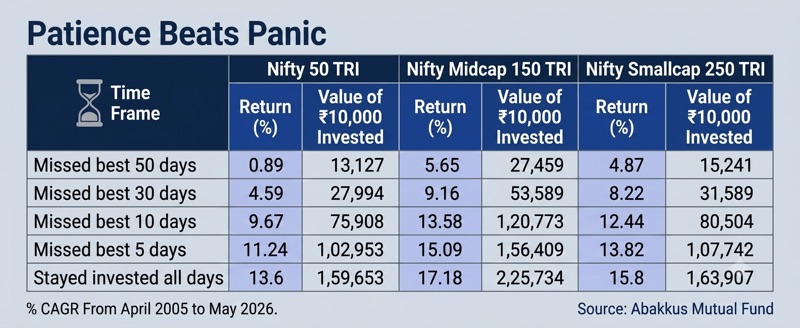
of passive index investing: Time IN the market beats timing the market.
Trying to predict short-term dips is a losing game. But holding a broad Index ETF continuously over a long period allows you to ride out short-term storms and let compound interest grow your money automatically.
The Big Trap: Why "Stay Invested" Doesn't Work for Individual Stocks
Here is where millions of
beginners get confused and lose their savings.
Many people buy a share of a
single company, watch its price crash, and tell themselves: "It's okay!
Passive investing means I just hold forever and stay invested!"
That is a massive trap.
Holding forever is a strategy for Index ETFs, not individual stocks. Stock picking is fundamentally an Active process, even if you try to hold the stock for years.
Think of it this way:
- Owning an Index ETF is like owning the entire
Premier League or IPL. Individual players get injured, perform poorly,
or retire, but new young superstars replace them. The league itself keeps
growing, making money, and attracting millions of fans forever.
- Owning a single stock is betting all your
money on one single player. If that player suffers a career-ending
injury, they don't bounce back.
Individual companies break down
all the time. Bad management, changing technology, heavy debt, or new
competitors can ruin a business. History is filled with massive, famous
companies that crashed, stayed broken for years, or went completely bankrupt.
If a company goes out of business, staying invested just means going down with
the ship.
"Buying the Dip": Smart for Indexes, Dangerous for Stocks
You have probably heard the
phrase "Buy the Dip"—which means buying more of an investment
when its price falls.
- Buying the dip on an Index ETF makes total
sense. When the whole market drops because of general economic panic,
the top 50 or 100 companies in the country are essentially going on a
temporary discount sale. The broader economy will eventually recover,
making it a great time to accumulate more units of the basket.
- Buying the dip on a single stock can be
financial ruin. If a company's stock drops 50%, it might not be a
"discount sale." It might mean the company's business model is
dying. Pouring more money into a failing stock is like trying to catch a
falling knife—it just hurts worse.
Which Path Should You Take?
Active Stock Investing is
meant for professionals and dedicated full-time researchers. It requires
reading corporate financial reports, evaluating industry competition, tracking
balance sheet health, and knowing when to cut your losses and sell when a
company is failing. If you treat stock picking as a passive,
"buy-and-forget" hobby, you are taking huge, unnecessary risks.
Passive Index Investing via
ETFs is designed for students, busy professionals, and everyday earners. It
removes the stress of researching individual companies, protects you from
single-company bankruptcies, and lets you build long-term wealth by
piggybacking on the natural growth of the overall economy.
If you want to Invest₹ight,
leave the high-speed race cars to the professionals. Grab yourself a solid
basket of top market index ETFs, stay invested through the noise, and let time
work for you!
📌 Author’s Bonus Note: Leveling Up Your Passive Strategy
Before you close this tab, here
are three high-level insights to take your passive investing strategy even
further:
- Strategic Asset Allocation is the True 10x
Multiplier: Passive index investing is powerful on its own, but
knowing how to allocate your funds across different asset
classes—such as equities, gold, and fixed income—acts as a 10x safety
shield and growth engine. Proper asset allocation ensures that even when
the stock market takes a dip, your overall portfolio stays resilient.
- The Middle Ground: Sectoral ETFs: If you
want to be slightly more active than a pure index investor—without taking
on the dangerous risk of picking individual stocks—consider Sectoral
ETFs (like Banking, IT, Pharma, or Infrastructure ETFs). They let you
back an entire growing industry rather than gambling on a single company
inside that industry.
- Learn from Arkad (The Richest Man in Babylon):
In George S. Clason's timeless financial classic, The Richest Man in
Babylon, the wealthiest man, Arkad, shares a fundamental truth: "Advice
is one thing that is freely given, but watch that you take only what is
worth having." Never take financial advice from noisy social
media influencers or well-meaning relatives who don't understand risk.
Always consult qualified, battle-tested financial advisers or
professionals who know the craft inside out.
Comments
Post a Comment
Have a question or confusion about this chapter? Drop a comment below—you can comment anonymously! No question is too basic.